
Every infill industrial landlord is fielding the same question right now: what about the robots? The concern is legitimate - Amazon, Walmart, and a wave of third-party logistics operators are pouring capital into automated storage and retrieval systems (AS/RS) that can run a distribution center with a fraction of the labor. The question is whether that disruption reaches infill small-bay real estate.
The answer, in short: structurally unlikely. The barrier isn't primarily cost. It's geometry.
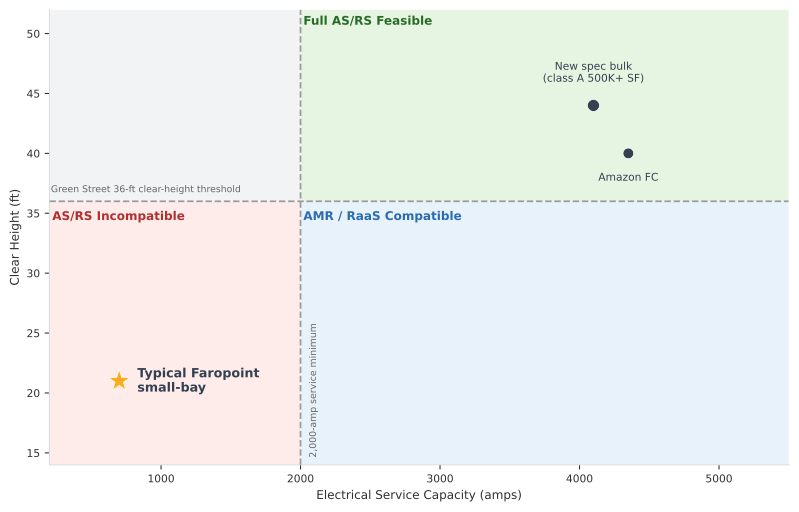
Source: Green Street Advisors; Faropoint Analysis, 2026
The chart above maps the two primary requirements for full AS/RS deployment - clear height (vertical axis) and electrical service capacity (horizontal axis) - and marks where different facility types actually sit. AS/RS requires a minimum of 36 feet of clear height and roughly 2,000 amps of electrical service to operate economically. Amazon fulfillment centers and new-spec bulk buildings reach those thresholds. A typical Faropoint small-bay building, at 18-28 feet of clear height and 600-1,200 amps of service, sits in the lower-left quadrant. The matrix boundary isn't a preference. It's physics.
The economics compound the physical constraints. For a 50,000 SF tenant paying approximately $750,000 in annual rent, a functional AS/RS installation starts at $5 million - 6.7 times annual rent. That hurdle doesn't move for a construction supply company, a regional 3PL, or a light manufacturer using their building as a combined production and distribution node. It moves only for billion-dollar e-commerce operators building purpose-built facilities. Those are different buildings serving different tenants in different locations.
Secondary constraints compound the problem. AS/RS systems require floor flatness ratings (F-numbers) in the FF50-FF100 range; most existing infill stock runs FF20-FF35. Dock ratios, column spacing, and power distribution architecture all require purpose-built design. Retrofitting an existing 1990s infill building for AS/RS isn't an underwriting risk - it's an engineering impossibility at any rent level that works.
The more relevant automation story for small-bay tenants is Robotics-as-a-Service (RaaS): fleet operators like Formic, Locus Robotics, and 6 River Systems deploy mobile robots on subscription pricing, no permanent buildout required, no clear-height threshold. A construction supply distributor can add pick-and-pack automation on a per-pick fee without touching the building shell. An auto parts wholesaler can run inventory cycle counts overnight with a robot fleet and zero capital expenditure. The real estate implication is the opposite of displacement - tenants become more productive inside their existing footprint and more likely to renew leases rather than right-size into smaller space. RaaS deepens the stickiness that small-bay infill already enjoys from its tenant base of operationally-rooted local and regional businesses.
Meanwhile, the supply side is moving further in favor of existing stock. Small-bay size bins currently carry just 0.3-1.1% of inventory under construction, compared to 2.6% for the 200,000 SF+ bulk category. With construction costs up 44% since 2019, the replacement cost for sub-100,000 SF infill now exceeds what market rents can support. The physical moat and the supply moat reinforce each other.
The buildings that automation disrupts are exactly the buildings that generate incremental demand for the buildings it cannot reach. The AS/RS buildout requires regional distribution and last-mile fulfillment nodes. Those nodes are small-bay. Where automation does intersect with industrial demand outside the four walls of the warehouse — autonomous trucking — is a different story, covered in Post 4.
For a full treatment of the AS/RS compatibility analysis, RaaS adoption trends, and how these factors shape Faropoint's acquisition filters, see How will AI impact small-bay industrial properties?
- Green Street Advisors. I.CON West conference notes — 36-ft clear-height automation compatibility threshold, March 2026.
- Swisslog AG. "Four Questions to Determine if AutoStore Is Right for Your Operation," 2024.
- Exotec SAS. Skypod System Technical Specifications, 2026.
- CBRE Investment Management. "The Case for Modern Logistics Facilities," 2024.
- Green Street News. "Robot-fleet operator developing issuance program (Formic Technologies)," February 13, 2026.
- Locus Robotics. "Locus Array: Beginning of the Autonomous Warehouse Era," 2025.
- Lee & Associates. "Small Bays, Big Opportunity." Research Report, 2025.
- CoStar Analytics. U.S. Industrial pipeline and construction data, 2026 Q1.
Latest Insights and Updates
.png)


.png)