
Aurora Innovation began driverless commercial trucking operations in Texas in April 2025. Kodiak Robotics and Gatik are running middle-mile freight routes for Walmart, Loblaws, and other large shippers. Investment committees are asking the natural follow-on question: is autonomous trucking a small-bay industrial risk? The short answer is that AV trucking will reshape long-haul and terminal-to-terminal freight — and that story lands almost entirely in big-box logistics, not in the urban infill small-bay segment. The risk is real but second-order, and our operating data shows no signal of it today.
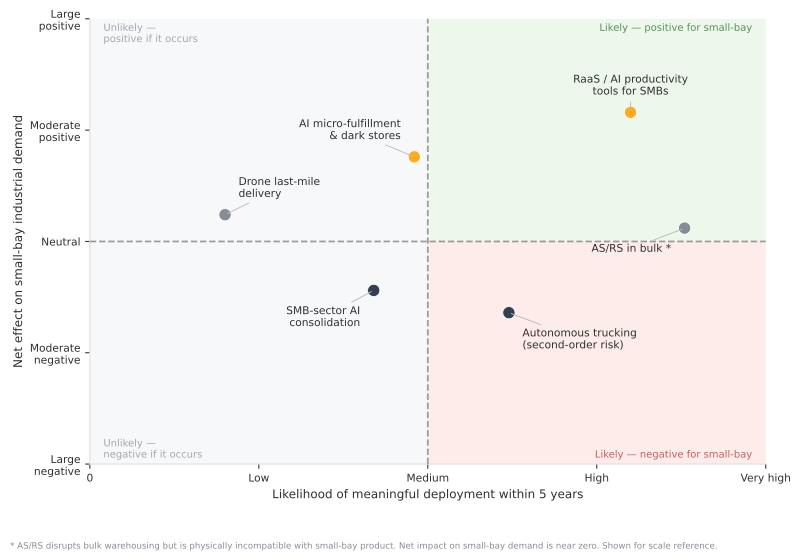
Source: Faropoint Research qualitative assessment, May 2026
The economics of autonomous trucking are built around driver-hour replacement on Interstate corridors. A Class 8 tractor running a fixed Texas-to-Arizona route overnight, crossing multiple states on a mapped highway, is where the value proposition is compelling and where the regulatory approvals have come fastest. This is a terminal-to-terminal, long-haul, fixed-route operation. The physical infrastructure that benefits — or faces repricing — is the large regional distribution center positioned near an Interstate interchange: the 300,000-600,000 SF bulk box that receives long-haul loads and breaks them for regional distribution.
Small-bay infill tenants operate in a different transportation geography entirely. An HVAC contractor in the Meadowlands runs a fleet of service vans on urban routes with multiple daily stops. A regional plumbing distributor makes 30-stop daily deliveries in a 50-mile radius of a 40,000 SF warehouse. A food-service supply company stages and delivers on city streets. These operations use Class 2-5 vehicles, not Class 8 long-haul trucks; they navigate dense urban environments on variable routes; and they rely on driver-customer relationships that aren't replaceable by current autonomy stacks. The regulatory landscape for urban BVLOS — beyond-visual-line-of-sight, city streets, mixed traffic — is a different, slower approval track than the highway corridor approvals Aurora and Kodiak have earned.
The horizon-risk matrix above shows how we think about this. Autonomous trucking sits in the "likely deployment / mild small-bay headwind" zone: meaningfully above the 50% likelihood line for commercial scale within five years on the long-haul segment, but with a net effect on small-bay demand that we assess as modestly negative rather than severe. The positive zone on the right side of the chart is occupied by developments — RaaS productivity tools, AI micro-fulfillment — that directly benefit small-bay tenants. AV trucking belongs to neither of those stories.
The indirect risk channel is the one worth monitoring. If AV economics drive shippers to consolidate their regional DC networks — fewer, larger hubs positioned closer to Interstate interchange points — some local distributors who today occupy small-bay infill could be absorbed by larger operators or rendered redundant by centralized models. This is the second-order risk: not that driverless trucks replace the vans in Faropoint's parking lots, but that the economics of the freight network shift in ways that reduce demand for the small regional distributor as a business type. We watch for this in SMB distributor churn and lease-renewal behavior across our portfolio. We have seen no instances of it in our operations to date.
What would change our assessment: accelerated FMCSA approvals for Class 8 BVLOS operations across the lower 48; major shipper announcements consolidating regional DC networks explicitly in response to AV-enabled long-haul economics; or an observed decline in SMB distributor formation rates in our core markets. None of those signals are present today. The driverless truck is a real technology with a real deployment trajectory. Its disruption to industrial real estate is concentrated in the segment — long-haul adjacent, 300,000+ SF, Interstate-oriented — where Faropoint does not operate.
The full taxonomy of AI-era horizon risks for small-bay industrial — autonomous trucking, SMB-sector consolidation, ecommerce trajectory, drone last-mile, and bulk-to-data-center conversions — and the framework we use to monitor them, is documented in How will AI impact small-bay industrial properties?
- Aurora Innovation. Aurora Driver Commercial Launch: Driverless Trucking in Texas, April 2025.
- Kodiak Robotics; Gatik. Commercial middle-mile operations and shipper partnership announcements, 2024-2025.
- Faropoint Research. Portfolio monitoring — SMB distributor churn and lease-renewal analysis, 2026.
Latest Insights and Updates
.png)


.png)